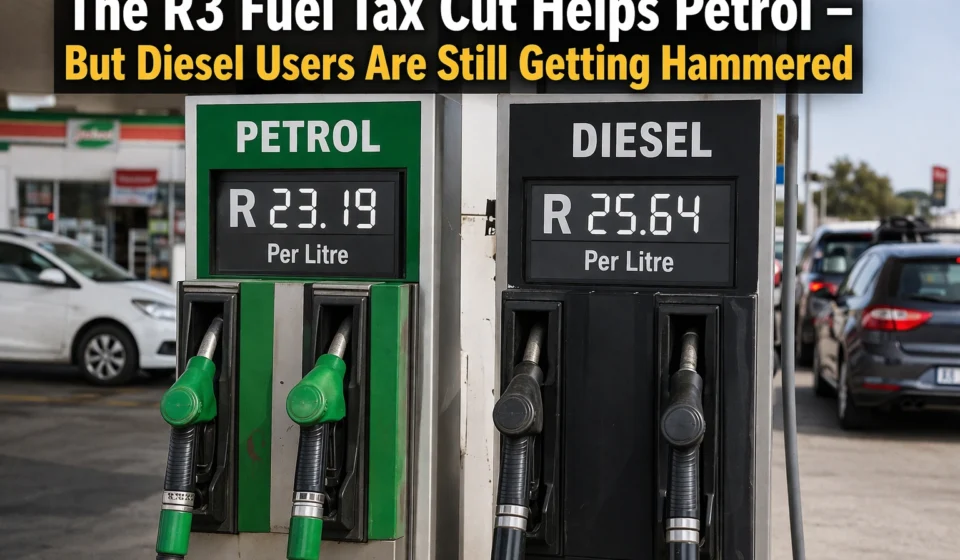

The R3 Fuel Tax Cut Helps Petrol – But Diesel Users Are Still Getting Hammered: South Africans woke up to a mix of relief and frustration as government announced a temporary fuel levy cut aimed at softening a massive fuel price shock. While petrol users are getting some breathing room, diesel users are still facing a heavy financial hit.
In a last-minute move, Finance Minister Enoch Godongwana introduced a R3 per litre reduction in the general fuel levy. The intervention, which runs from 1 April to 5 May 2026, is meant to cushion households and businesses from surging global oil prices.
But here’s the key truth: fuel prices are still going up significantly. The tax cut simply reduces how painful the increase would have been.
What You Should Know First
- Fuel prices are rising sharply despite the R3 tax cut
- Petrol increases are smaller because the levy reduction helps more
- Diesel prices are still surging by over R7 per litre
- The main drivers are global oil prices and a weaker rand
- The relief is temporary and may not continue beyond May
In short, the intervention helps—but it doesn’t solve the problem.
Understanding the Price Shock: What’s Actually Changing?
Let’s break down what motorists are facing.
Fuel Price Increases (After the R3 Relief)
- Petrol (93 & 95): +R3.06 per litre
- Diesel (0.05%): +R7.37 per litre
- Diesel (0.005%): +R7.51 per litre
- Illuminating paraffin: +R11.67 per litre
Without the levy cut, petrol would have increased by over R6 per litre, and diesel by more than R10.
What This Means
- Petrol users are paying about half the increase they would have
- Diesel users are still absorbing a massive cost spike
This is why the headline—The R3 Fuel Tax Cut Helps Petrol – But Diesel Users Are Still Getting Hammered—is accurate.
Why Petrol and Diesel Are Affected Differently
At first glance, it might seem unfair. Why does petrol get more relief than diesel?
Step-by-Step Explanation
- The fuel levy is only one part of the price
- Petrol levy reduced from R4.10 → R1.10
- Diesel levy reduced from R3.93 → R0.93
- Other costs are rising sharply
- Global oil prices
- Exchange rate (rand vs dollar)
- Additional taxes (RAF levy, carbon tax)
- Diesel is more exposed to global markets
- Diesel prices are more directly influenced by international demand and supply
- It is heavily used in industry, transport, and agriculture
Real-World Example
Think of fuel pricing like a bill:
- The levy cut is a discount
- But the base price (oil) has increased dramatically
So even with a discount, the final bill is still higher—especially for diesel.
What This Means for Your Wallet
Let’s translate these numbers into real-life impact.
Estimated Extra Cost Per Tank
| Vehicle Type | Tank Size | Extra Cost |
|---|---|---|
| Small petrol car | 45L | ~R2.70 more |
| Midsize petrol car | 60L | ~R3.60 more |
| Diesel SUV/Bakkie | 60L | R262 – R271 more |
Key Insight
- Petrol users will barely notice the increase per tank
- Diesel users will feel a serious financial strain
This is especially important for:
- Delivery drivers
- Farmers
- Taxi and logistics operators
The Real Cause: Global Oil and Currency Pressure
The fuel crisis isn’t happening in isolation.
What’s Driving the Spike?
- Rising global oil prices
- Brent crude jumped from $69.08 to $93.67 per barrel
- Weaker South African rand
- From R16.00 → R16.64 per US dollar
- Geopolitical tensions
- Conflict in the Middle East is disrupting supply and pushing prices up
Why This Matters
South Africa imports most of its fuel. That means:
- Higher oil prices = higher fuel costs
- Weaker rand = even higher import costs
These two factors combined create a perfect storm for price increases.
Impact on the Economy: More Than Just Fuel
Fuel prices affect more than just drivers—they ripple through the entire economy.
Key Sectors Hit Hardest
- Agriculture (diesel-powered machinery)
- Transport & logistics (trucks, delivery fleets)
- Food production (processing and distribution)
Organizations like COSATU have warned that workers already struggling financially may not cope with rising costs.
Meanwhile, Organisation Undoing Tax Abuse (Outa) noted that while the tax cut helps, it’s still a “hard knock” for consumers.
What Happens After May?
Here’s where uncertainty comes in.
The R3 levy cut is:
- Temporary (1 April – 5 May 2026)
- Subject to monthly review
According to Enoch Godongwana, extending the relief further could strain government finances.
The Cost
- The intervention costs around R6 billion for one month
- Government will need to recover this money elsewhere
Possible Outcomes
- Relief extended (unlikely long-term)
- Prices remain high or increase further
- Additional support measures introduced
Panic Buying: What You Need to Know
In the days before the price hike, many motorists rushed to fill up tanks.
Why This Is a Problem
- Temporary fuel shortages at stations
- Increased pressure on supply chains
- No actual national shortage
Government Message
There is enough fuel supply nationally—shortages are due to panic buying, not scarcity.
Common Misunderstandings About The R3 Fuel Tax Cut Helps Petrol – But Diesel Users Are Still Getting Hammered
1. “Fuel prices are going down”
Not true. Prices are still increasing, just less than expected.
2. “Diesel users are getting the same relief”
Technically yes—but in reality, diesel prices are rising much faster.
3. “Government can keep cutting taxes”
This is limited. Fuel levies fund essential services, including road accident support.
4. “This is a local problem only”
Global oil markets and currency shifts are the main drivers.
Key Takeaways
- The R3 levy cut reduces—but does not stop—fuel price increases
- Petrol users benefit more, with minimal per-tank increases
- Diesel users face steep cost hikes of over R7 per litre
- Global oil prices and a weaker rand are the main causes
- The relief is temporary and may not continue beyond May
- Economic pressure will likely increase across multiple sectors
Frequently Asked Questions (FAQs)
1. Why is diesel increasing more than petrol?
Diesel is more influenced by global demand and supply, especially in industrial sectors. This makes its price more volatile during global disruptions.
2. How long will the R3 fuel levy cut last?
It is currently set from 1 April to 5 May 2026, with possible monthly reviews.
3. Will fuel prices go down soon?
That depends on global oil prices and the rand. If these improve, prices could stabilize—but there are no guarantees.
4. How can I reduce fuel costs right now?
- Carpool where possible
- Combine trips
- Avoid aggressive driving
- Keep tyres properly inflated
Final Thoughts
The R3 fuel levy cut is a meaningful but temporary intervention during a period of extreme global pressure. It has softened the blow—especially for petrol users—but has not prevented a significant rise in fuel costs.
Diesel users, in particular, are bearing the brunt of the increase, with ripple effects expected across food prices, transport costs, and the broader economy.
As the situation evolves, staying informed and adjusting your fuel usage habits may be the best way to manage the impact. The coming months will be critical in determining whether further relief is possible—or whether South Africans must prepare for continued pressure at the pumps.
Also read about: Possession of Drugs Worth More Than R5m