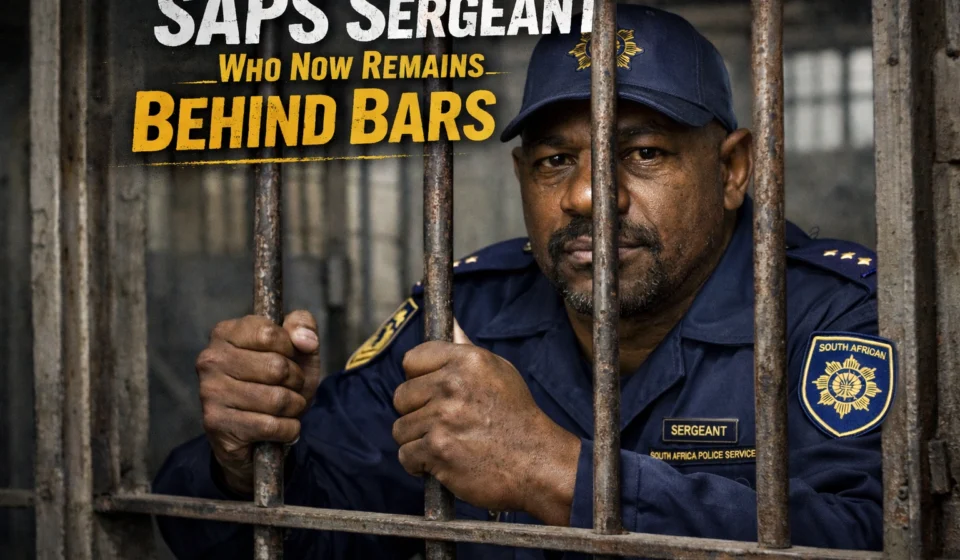

SAPS Sergeant Who Now Remains Behind Bars: The courtroom fell silent as Magistrate Thandi Theledi delivered her ruling. The Sgt Fannie Nkosi remains behind bars saga had taken another dramatic twist—this time with the suspended police officer losing his bid for a hospital wing cell. The 42-year-old Organised Crime Unit member, once a key witness before the Madlanga Commission of Inquiry, now finds himself counting days in the general population of Kgosi Mampuru Correctional Facility. And he may be there for a long while yet.
The case of Sgt Fannie Nkosi remains behind bars is more than just a bail hearing. It’s a story of trust betrayed, a badge tarnished, and a commission of inquiry that has exposed deep rot within South Africa’s law enforcement. Here is everything you need to know about this extraordinary case.
Who Is Sergeant Fannie Nkosi?
Before the handcuffs went on, Fannie Nkosi was a veteran member of the Gauteng SAPS Organised Crime Unit. He had spent years investigating cash-in-transit heists and violent crimes. But in 2025, he stepped into a very different spotlight.
The Madlanga Commission Connection
Nkosi testified before the Madlanga Commission of Inquiry for eight days, making explosive claims about his alleged links to criminal cartel figures. He named Vusimuzi “Cat” Matlala and Katiso “KT” Molefe as his associates. He also alleged that senior police officers were connected to organised crime networks.
But instead of emerging as a whistleblower hero, Nkosi became a target of the very inquiry he helped. The Madlanga Commission task team, established to investigate corruption within the SAPS and Tshwane municipality, turned its attention to Nkosi himself. On 2 April 2026, they raided his home in Pretoria North.
The April Raid: What Police Found Inside Nkosi’s Home
The search warrant was executed just days after Nkosi completed his testimony. What officers allegedly discovered was staggering.
Items seized during the raid:
- More than R50,000 in cash, concealed beneath a mattress
- Seven licensed firearms and ammunition, some allegedly unsecured
- One stun grenade (described as a state-owned hand grenade)
- Six original case dockets, some dating back to 2016, that were never finalised
- State-issued items, including a 9mm revolver allegedly found under the bed of Nkosi’s eight-year-old son
The discovery of case dockets at a private residence was particularly alarming. Police spokesperson Brigadier Athlenda Mathe told journalists that closed dockets are supposed to be kept in a police station’s storage room—and once archived, they may not be in the possession of any investigating officer.
The Charges: A Long List of Allegations
Following the raid, Nkosi was arrested and charged with multiple offences.
Full list of charges against Sgt Fannie Nkosi:
| Charge | Details |
|---|---|
| Unlawful possession of explosives | Alleged stun grenade found at his home |
| Three counts of failing to safeguard firearms | Firearms allegedly found outside a compliant safe |
| Eight counts of failing to safeguard ammunition | Large quantity of ammunition recovered |
| Defeating the administration of justice | Possession of closed case dockets |
| Failure to comply with firearm safe regulations | Safe allegedly not SABS-compliant |
| Theft | Dockets allegedly stolen from police stations |
Additionally, the State accused Nkosi of acting as a middleman between Matlala and senior police officers. The NPA also alleged that he protected suspects involved in cash-in-transit robberies and violent crimes.
Courtroom Drama – The Bail Hearing That Didn’t End
On 13 April 2026, Nkosi appeared before the Pretoria North Magistrate’s Court for his formal bail application. What followed was a tense legal battle that exposed deep divisions between the State and the defence.
The State’s Case Against Bail
Prosecutor Tholoana Sekhonyana argued forcefully that Sgt Fannie Nkosi remains behind bars is the only safe option for the public.
“The applicant has shielded serious criminals who are involved in violent crimes like cash-in-transit robberies with aggravating circumstances, instead of bringing them to court to account for their alleged wrongdoing.”
The State further warned that:
- Nkosi is well-connected to senior police officials who could help him obstruct justice
- He has links to criminal networks involved in robbery and heists
- If released, there is a real likelihood he will interfere with investigations and continue “obstructing other matters”
Nkosi’s Defence – “A Plot to Victimise Me”
Nkosi, through his lawyer Advocate Sizo Dlali, denied every allegation. He submitted an affidavit telling the court:
- He earns R16,500 per month and can afford bail of R10,000
- He is married with one child and owns a home bonded for R1.5 million
- He has no previous convictions and is not a flight risk
- The firearms were all licensed and kept in a wall-mounted safe
- The dockets were in his possession as part of his duties in a national task team dealing with heists and violent crime
- The stun grenade allegation is a “fabrication”
“I contend that the state’s case is weak and non-existent. This is a plot to victimise me.”
Hospital Wing Denied – Magistrate Rejects Fears of Poisoning
In a separate application, Nkosi asked to be held in the hospital wing of Kgosi Mampuru Correctional Facility. He raised two concerns:
- His health: He is diabetic and requires medical attention
- His safety: He feared being poisoned in the general population
Magistrate Thandi Theledi was not persuaded.
“Diabetes alone does not justify admission to a hospital wing. The facility is intended for detainees who require medical treatment, observation or nursing care, and not as a form of protective custody without medical necessity.”
On the poisoning claim, Theledi said there was no clear basis for the concern. She added:
“I am not going to micromanage the prison. Prison authorities are responsible for ensuring the safety and well-being of all detainees.”
Result: Nkosi was ordered to remain in the general population unless prison officials determine otherwise.
Why the Bail Hearing Was Postponed
Despite a full day of arguments, no decision on bail was reached. The hearing was postponed to 20 April 2026 due to the unavailability of the state prosecutor.
This means Sgt Fannie Nkosi remains behind bars for at least another week—and possibly much longer if the State has its way.

The Bigger Picture – A System Under Scrutiny
The arrest of Fannie Nkosi is not an isolated incident. The Madlanga Commission has already resulted in 12 police officers being arrested and City of Tshwane officials being suspended.
Expert Reactions
Criminologist Witness Maluleka was scathing about Nkosi’s commission testimony:
“He mostly lied and fabricated non-existent realities. He went there to ridicule the sitting. Even a novice can see that he used the commission as a circus.”
Criminal law expert Cornelia van Graan welcomed the swift police action:
“The police can be commended for their swift and accurate response. However, I was shocked to hear what items were recovered from the house. It indicates a lack of safeguards and proper procedures on the side of the police.”
She added: “A police sergeant is tasked with ensuring the safety of all people residing in South Africa. His actions in keeping firearms and even a hand grenade show a blatant disregard for life.”
What Comes Next?
For now, Sgt Fannie Nkosi remains behind bars—isolated from the high-stakes world of organised crime investigations, separated from his wife and eight-year-old son, and awaiting a legal reckoning that could define his legacy.
The State has signalled it will continue opposing bail. The defence has labelled the case “weak and non-existent.” The magistrate will have the final word on 20 April.
One thing is certain: whether he walks free or stays locked up, the name Fannie Nkosi will be remembered as a cautionary tale—a man who went from investigating crime to being accused of enabling it.