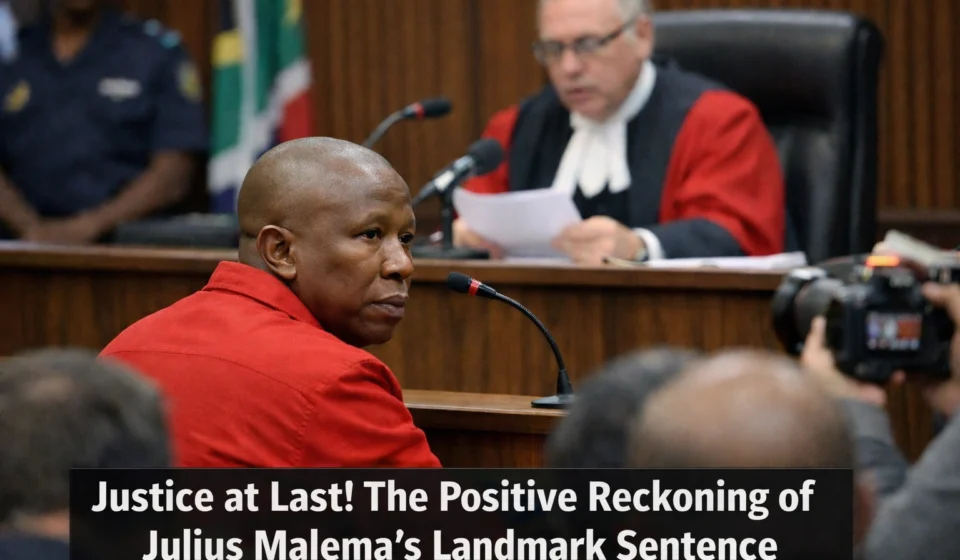

Julius Malema’s Landmark Sentence: For seven long years, the case has wound its way through the South African legal system like a slow-moving storm. A video showing a prominent political leader firing a rifle into a crowd of thousands became the centre of a national debate about accountability, power, and the rule of law. Now, after years of legal battles, the moment of reckoning has finally arrived. The Julius Malema sentencing is poised to be a watershed moment in the country’s democratic history—a positive affirmation that no one, regardless of status, is above the law.
At the East London Magistrate’s Court, Magistrate Twanet Olivier is expected to deliver her judgment on Thursday, 16 April 2026, determining whether the Economic Freedom Fighters (EFF) leader will face a custodial sentence for a 2018 incident where he fired a semi-automatic rifle into a crowd of his own supporters at the Sisa Dukashe Stadium in Mdantsane. The Julius Malema sentencing has captured the nation’s attention, as the outspoken firebrand awaits a decision that could fundamentally alter the political landscape and send a clear, positive message that justice is blind.
The Day of Reckoning: What to Expect from the Historic Julius Malema Sentencing
The Julius Malema sentencing follows a dramatic two-day proceeding where the National Prosecuting Authority (NPA) and the defence laid out their final arguments. The courtroom was packed with family members, including Malema’s wife, Mantwa, and his son, Ratanang, while hundreds of EFF supporters gathered outside, watching the proceedings on big screens. The atmosphere was tense, but there was also a sense of hope—hope that the law would finally speak clearly.
The state is pushing for a harsh, custodial sentence, arguing that Malema’s actions endangered the lives of over 20,000 people and that his position as a public figure demands an exemplary punishment. The defence, however, has pleaded for leniency, citing the lack of injuries, his status as a first-time offender, and the brief duration of the incident. Regardless of the outcome, the fact that a sitting political leader is being held accountable is a victory for South African democracy.
The State’s Case: ‘The Show is Over’
State Prosecutor Advocate Joel Cesar has been relentless in his argument that anything less than prison time would be a grave injustice. He told the court that Malema’s actions were not a spontaneous accident but a deliberate act that displayed a malicious disregard for human life.
Danger to the Public
Cesar emphasised that Malema fired multiple live rounds into a densely packed stadium, putting more than 20,000 people at risk. He argued that the fact no one was injured was “by the grace of God,” not due to any caution on Malema’s part. This is a powerful point: recklessness that could have caused a massacre should not be excused simply because luck intervened.
The ‘Pandora’s Box’ of Influence
The state argued that as a lawmaker and a leader with a massive youth following, Malema’s actions opened a “Pandora’s Box.” By firing a weapon in public, he created a dangerous impression that such reckless behaviour is acceptable. Leaders must set examples, not excuses.
No Remorse
The NPA highlighted Malema’s lack of remorse, pointing out that he continues to claim the case is a political conspiracy despite “overwhelming evidence” against him, which the state views as an aggravating factor. A genuine apology can go a long way, but it has been conspicuously absent.
The Demand
Cesar urged the court to say “the show is over,” requesting a sentence ranging from 7 to 15 years in prison to send a deterrent message to would-be offenders. That is a serious ask, but it reflects the gravity of the offence.
The Defence’s Plea: A ‘Shockingly Inappropriate’ Jail Sentence
Advocates Tembeka Ngcukaitobi and Laurence Hodes SC have mounted a vigorous defence, arguing that a custodial sentence would be a gross miscarriage of justice.
A Two-Minute Incident
Hodes argued that while Malema was convicted on five charges, they all stem from a single event lasting no more than two minutes. He maintained that sending someone to prison for such a brief, celebratory act is “shockingly inappropriate”. From that perspective, a fine or community service might seem more proportional.
No Harm, No Foul
The defence hammered home that there were no injuries, no property damage, and no witness testified to being in fear for their lives during the incident. This is a strong mitigating factor—intent and outcome are both important in sentencing.
A First-Time Offender
Malema’s legal team highlighted his clean record, noting that as a first-time offender with no prior convictions, the court should lean towards a non-custodial sentence. South African courts generally favour rehabilitation over incarceration for first-timers.
A Fine is Appropriate
Hodes proposed alternative penalties, such as a fine or a suspended sentence, arguing that imprisonment is not the only option for justice. A hefty fine, for instance, would still punish the offence while keeping Malema in his parliamentary role.
The High Stakes: What a Prison Sentence Means for Malema
The political ramifications of the Julius Malema sentencing are as significant as the legal ones. If Magistrate Olivier sentences him to more than 12 months in prison without the option of a fine, Malema will automatically lose his seat in Parliament and be disqualified from holding public office for five years. That would be a seismic shift in South African politics, potentially weakening the EFF and reshaping the opposition landscape.
This has led to fiery rhetoric from his supporters. Mahlatse Dlamini, chairperson of the UCT EFF Youth Command, warned, “If the commander-in-chief is jailed, we are going to render the country ungovernable”. However, Malema himself has called for calm, urging supporters not to engage in violence and to wait for the party leadership’s direction. That is a responsible stance, and it shows a glimmer of respect for the legal process.
Malema’s Defiance: ‘I Am Too Old to Be Shaken’
Despite the life-altering consequences hanging in the balance, Julius Malema has projected an image of unshakeable defiance. Addressing a large crowd of red-beret supporters outside the KuGompo City Magistrate’s Court on Wednesday, he dismissed the state’s case and his detractors with characteristic bravado.
“I stand before you unshaken by the threats of white supremacists – and because I fought them when I was still young, I am too old to be shaken by young Afrikaner boys when I have defeated their parents.”
He insisted he would return home after the ruling and vowed to fight the case all the way to the Constitutional Court. “It doesn’t matter the outcome. The fact that there is a guilty verdict, we are going to appeal this case until the highest court in the land,” he said. That is his right, and it is a positive sign that he intends to use legal channels rather than extra-legal means.
The Verdict Countdown
The proceedings have been nothing short of dramatic. On Wednesday, Magistrate Twanet Olivier announced she needed more time to draft her sentence, postponing the matter until Thursday. The delay has only heightened anticipation, but it also reflects the magistrate’s care and diligence—she is not rushing a decision that could change a man’s life and a nation’s politics.
| Aspect | Details |
|---|---|
| The Accused | Julius Malema, EFF Leader |
| The Incident | Firing a rifle at the Sisa Dukashe Stadium, Mdantsane (28 July 2018) |
| The Verdict | Found guilty on 5 charges (Oct 2025) |
| State Demand | 7-15 years imprisonment |
| Defence Plea | Non-custodial sentence (Fine/Suspended) |
| Potential Loss | Parliamentary seat if sentenced to >12 months without fine option |
A Positive Step for South African Democracy
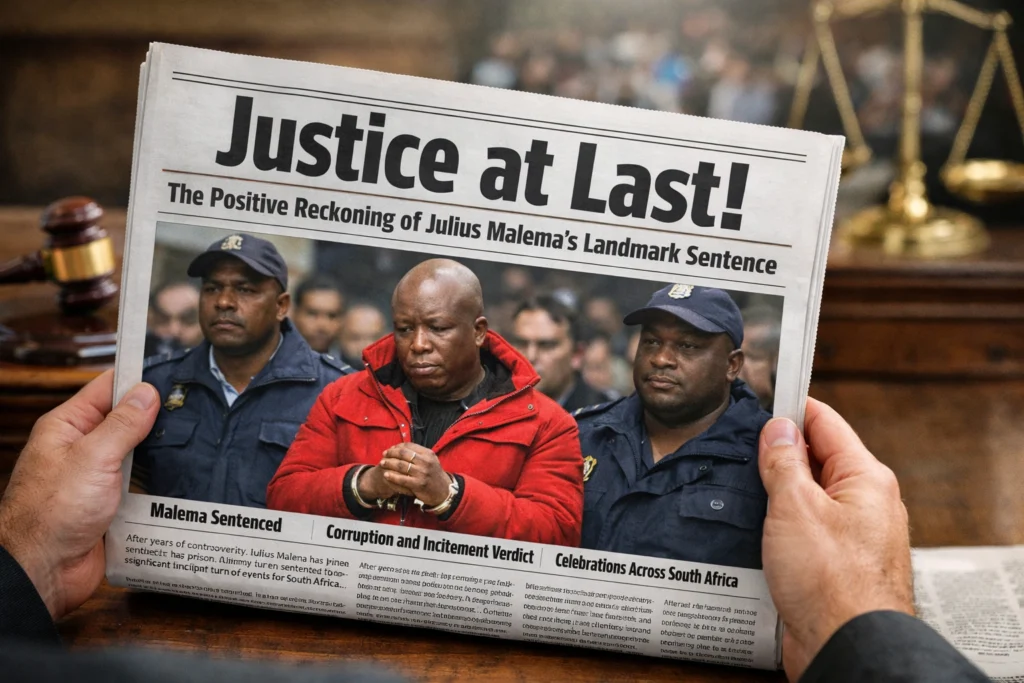
Regardless of whether Magistrate Olivier hands down a prison sentence or a fine, the Julius Malema sentencing is already a victory for the principle of equality before the law. For years, many South Africans have felt that powerful politicians operate with impunity. This case has shown that even the most charismatic and controversial leader can be held accountable.
The fact that the NPA pursued this case for seven years, that the courts treated it with seriousness, and that a magistrate is now carefully weighing the appropriate sentence—all of this strengthens public trust in the judiciary. It sends a clear message: no one is above the law, not even a man who commands a massive political following.
Moreover, Malema’s own call for calm among his supporters is encouraging. He has urged them not to engage in violence and to respect the legal process. That is the behaviour of a leader who, despite his defiance, understands the boundaries of democratic society. It bodes well for a peaceful resolution, whatever the sentence may be.
What Happens Next?
If Magistrate Olivier imposes a custodial sentence of more than 12 months without a fine option, Malema will be taken into custody immediately. His lawyers will then likely file an appeal, and he could apply for bail pending that appeal. The legal wrangling could continue for months or even years.
If the sentence is a fine or a suspended sentence, Malema will remain free and retain his parliamentary seat. He will almost certainly appeal the guilty verdict itself, taking the case to the High Court, the Supreme Court of Appeal, and potentially the Constitutional Court. Either way, the Julius Malema sentencing is far from the final chapter.
But the most important thing is that the law has spoken. The video evidence was clear. The court found him guilty. And now, a magistrate will decide the price of that recklessness. That is how democracy works. That is how justice works.
Final Thoughts: A Verdict for the Nation
The Julius Malema sentencing is far more than a routine court appearance; it is a test of South Africa’s constitutional democracy. It asks a fundamental question: are the laws of the land truly blind, or do they bend for the powerful?
As the nation holds its breath, the decision in Magistrate Olivier’s hands will either reinforce the principle of equality before the law or be seen as another example of justice deferred for the political elite. But regardless of the outcome, the fact that this case has reached this point is a positive sign. It shows that the institutions are working. It shows that no one can simply wave away serious criminal charges with political rhetoric.
Malema himself has said he will appeal. That is his right. But the guilty verdict stands. And now, the sentence will come. Whether it is prison or a fine, the message is clear: fire a weapon into a crowd, and you will face the consequences.
That is a lesson every South African—especially those in power—should take to heart. The Julius Malema sentencing is a milestone. Let us hope it is a turning point towards greater accountability for all.
Up next: The judgment is expected to be delivered on Thursday morning. The eyes of the nation are on KuGompo City.