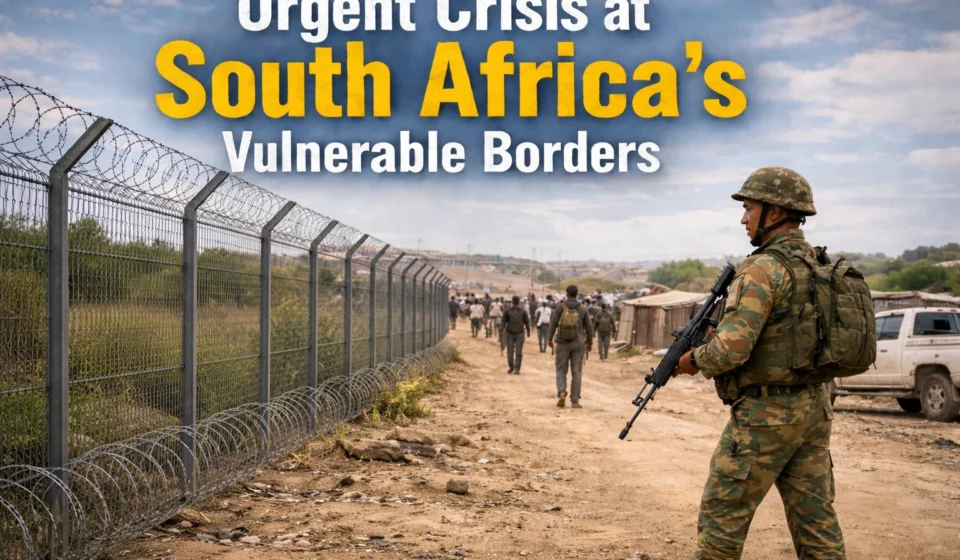

Urgent Crisis at South Africa’s Vulnerable Borders: Imagine a national border stretching over 4,800 kilometers. Now imagine trying to guard it with just 600 border guards.
That’s one border guard for every eight kilometers of frontier. And that’s just the beginning of the problem.
The truth is stark: South Africa’s borders are effectively wide open. Parliamentary committees have admitted it. Military officials have confirmed it. And communities living along the Limpopo River see it every single day.
This is a spotlight on South Africa’s vulnerable borders—why they’re so exposed, what’s crossing through them, and what the government is finally doing about it.
South Africa’s Porous Borders – A National Security Crisis
If you’ve been following the news, you’ve heard the term “porous borders.” But what does that actually mean on the ground?
Let me give you the hard numbers.
The Joint Standing Committee on Defence conducted an oversight visit to border areas near Musina in October 2025. What they found shocked even them .
“If we are being honest, we don’t have functioning borders, and this puts the safety of our country at risk.”
— Chairperson of the Portfolio Committee on Defence and Military Veterans
This isn’t alarmist rhetoric. This is the official assessment from Parliament’s own defence committees.
The Manpower Crisis – Too Few Boots on the Ground
Let’s break down the numbers.
What the SANDF needs:
What the SANDF actually has:
But here’s where it gets worse.
The Border Management Authority (BMA) shortfall:
- Approved structure calls for 11,115 personnel
- Only 2,566 positions filled
- That’s 8,549 vacancies
- Current funding shortfall: over R2.2 billion
Let that sink in. The agency responsible for managing South Africa’s borders is operating at less than 25% of its intended capacity.
As Home Affairs Minister Dr Leon Schreiber admitted to Parliament:
“We have 600 border guards, but we have 4,500 kilometres of border. That’s not sufficient.”
The Technology Gap – Fighting a Modern War with Old Tools
Here’s something that might surprise you.
While smugglers use drones, encrypted phones, and sophisticated tracking systems, South Africa’s border guards are struggling with basic equipment.
The SANDF told parliamentary committees that they lack:
- Drones for aerial surveillance
- Modern vehicles for rapid response
- Thermal scanners for detecting illegal crossings at night
Dr Malusi Gigaba, Co-Chairperson of the Joint Standing Committee on Defence, put it bluntly:
“You do not have enough boots on the ground. You do not have enough numbers of soldiers. They don’t have enough equipment, including technology, to undertake this mammoth task with great competency.”
And there’s another risk: the truck scanner at Beitbridge—one of the busiest border posts in Africa—is so poorly maintained that if it breaks down, cargo scanning could grind to a halt .
The Human and Economic Cost of Open Borders
So what’s actually crossing these unguarded borders?
The answer is almost everything you can imagine.
Illicit Trade – R83 Billion Down the Drain
Let me share a staggering figure.
South Africa loses an estimated R83 billion annually to illicit goods and substances flowing through unsecured borders .
The parliamentary committee identified Beitbridge, Durban harbour, and OR Tambo International Airport as “national key points where there is a serious national threat” .
What’s crossing the border illegally?
- Counterfeit goods
- Undeclared cargo evading SARS duties
- Stolen vehicles
- Illicit tobacco
- Illegal medicines
One committee member highlighted a specific case: after a fatal bus accident, wreckage revealed large quantities of medicines being smuggled for distribution—a clear sign of evading customs duties .
Human Trafficking and Undocumented Crossings
Remember that bus accident mentioned earlier?
Here’s the full story.
A bus traveling from Gqeberha (Port Elizabeth) to Harare was licensed to carry 61 passengers. When investigators counted, they found 91 people on board—mostly Zimbabweans and Malawians returning home, many without any identification documents .
“The bus that was involved in a fatal accident, where 40 mostly undocumented foreign nationals lost their lives, shows the ease with which people can pass through South Africa’s checkpoints. Obviously, the enablers are on our side of the border.”
— Dr Malusi Gigaba
This isn’t just about migration. It’s about organized crime.
Syndicates buy trucks, hire drivers, and transport illicit goods and people across border lines with shocking ease . The committees observed damaged fencing and areas where illegal crossings happen regularly—right under the noses of too-few soldiers .
Strain on Local Communities
The impact isn’t just national. It’s local.
ActionSA Mpumalanga MPL Thoko Mashiane describes what communities experience:
“Overwhelmed clinics, overcrowded schools, strained housing, and law enforcement stretched beyond capacity.”
The reality in border-adjacent communities includes:
- Informal settlements near the Limpopo River where some residents reportedly aid illegal crossings
- Health facilities unable to cope with demand
- Schools bursting at the seams
- Housing shortages exacerbated by unplanned population growth
Mashiane makes a crucial point:
“Every unrecorded patient, unaccounted learner, and unmonitored settlement stretches systems that were already failing South Africans.”
What’s Being Done – The Government’s Response Plan
Okay, the situation sounds dire. But here’s the good news: the government is finally taking serious action.
The Budget Boost – Billions for Border Security
The 2026 National Budget includes significant allocations for border security .
Key funding commitments:
- R990 million additional for the Border Management Authority to fill 738 positions
- R2.7 billion added to Defence over the medium term to improve operations
- R1 billion to the SANDF from the Criminal Assets Recovery Account for fighting organized crime
- R1 billion to the police service
Total peace and security spending increases from R268.2 billion in 2025/26 to R291.2 billion in 2028/29 .
That’s serious money. But will it be enough?
The SONA 2026 Announcements
In his February 2026 State of the Nation Address, President Cyril Ramaphosa laid out a clear plan .
Five key interventions:
- Prioritized funding for border security covering infrastructure, technology, and personnel
- Public-private partnerships to redevelop key border posts
- Electronic Travel Authorisation extended to all international airports and busiest land ports
- 10,000 new labour inspectors to crack down on employers hiring undocumented foreign nationals
- Coordinated enforcement with police, Home Affairs, and labour inspectors working together
The President was firm:
“Employers that hire foreign nationals without the required visas will face the full might of the law.”
But he also balanced enforcement with human rights:
“No foreign national should be unlawfully barred from accessing public facilities, including schools and health facilities.”
The One-Stop Border Post Bill
There’s also legislative reform underway.
The One-Stop Border Post Bill proposes creating shared border zones where South African and neighbouring country officials conduct immigration, customs, and security checks together in one place .
The promise: Reduced delays, faster trade, more efficient enforcement.
The timeline: This process has been ongoing for nine years, according to Minister Schreiber .
The criticism: Human rights groups like the Scalabrini Centre warn that asylum seekers could be “bounced” between countries or face unlawful detention because the bill doesn’t clarify responsibility in shared zones .
Lawyers for Human Rights also raised concerns that border officials could deny entry to asylum seekers who entered through unofficial ports—even if they’re legally entitled to protection .
What Still Needs to Happen
Despite the funding announcements, parliamentary committees continue to push for more.
The Standing Committee on Appropriations, chaired by Dr Mmusi Maimane, called for “urgent steps and political will to ensure adequate funding” .
Key recommendations from Parliament:
- Better interdepartmental cooperation (SANDF, BMA, SAPS, SARS, Home Affairs)
- Collection of donkeys used for illegal cross-border activities
- Addressing the “enablers on our side of the border”—including corrupt officials
- Prisoner exchange agreements with neighbouring countries
A Border Crisis That Demands Action
Let me be honest with you.
South Africa’s vulnerable borders aren’t vulnerable because of geography. They’re vulnerable because of underfunding, understaffing, and under-prioritization.
The numbers don’t lie:
- 600 border guards for 4,800 kilometers
- 8,500 vacancies at the BMA
- R83 billion lost to illicit trade annually
- 22 companies needed, only 15 available
But here’s what gives me hope.
The 2026 budget includes billions in new funding. The President has made border security a SONA priority. Parliamentary committees are pushing hard for accountability. And the One-Stop Border Post Bill, however imperfect, shows legislative movement.
The question isn’t whether South Africa can secure its borders. The question is whether the political will will hold long enough for the funding to translate into actual boots on the ground, drones in the air, and scanners at the ports.
For the communities along the Limpopo River—and for the national security of all South Africans—the answer needs to be yes.
And yes, quickly.