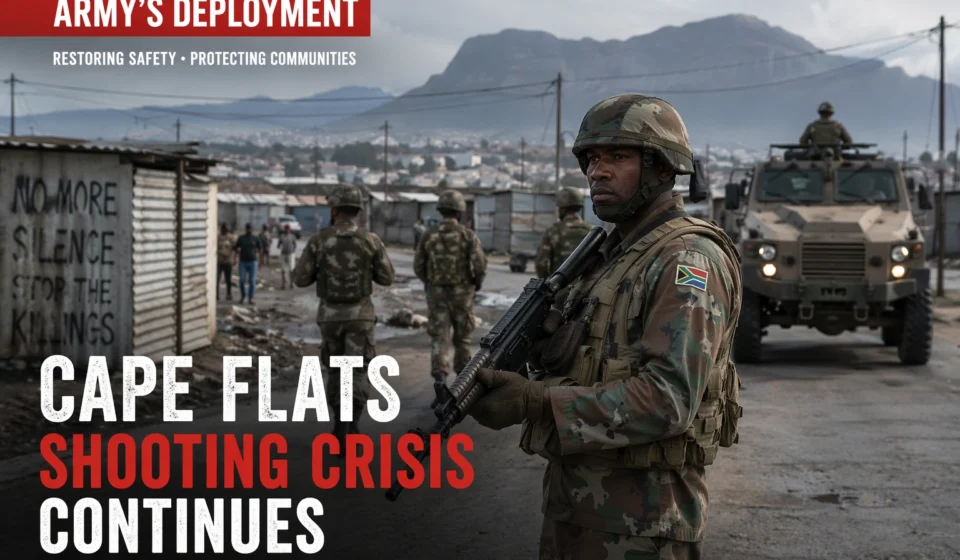

Cape Flats Shooting Crisis Continues: You know that feeling when you hear about a government intervention, and you think: finally. But weeks later, nothing has changed. The bullets keep flying. The body bags keep filling. And the community keeps bleeding.
That is the brutal reality on the Cape Flats right now.
President Cyril Ramaphosa ordered the deployment of 2,200 soldiers to the Western Cape in a blaze of political promise. The media showed images of camouflage and rifles. Residents dared to hope. Yet the shootings persist in Cape Flats despite army deployment, and the numbers are nothing short of devastating.
Let me take you inside the carnage, the confusion, and the heartbreaking reality of Operation Prosper.
The Shocking Numbers: A Week of Bloodshed That Defied the Army’s Presence
If you thought the army’s arrival would bring immediate peace, the statistics tell a very different story.
36 Killed in One Week – A War Zone by Any Measure
In the week of March 30 to April 5, 2026, gang-related violence in and around the Cape Town metro left 36 people dead and 47 others wounded. That is not a typo. Thirty-six lives extinguished in a single week, according to the National Assembly’s Portfolio Committee on Police Chairperson Ian Cameron.
Across the entire Western Cape, violent crime and gangsterism have resulted in the killing of about 345 people since the beginning of 2026. Critics have rightly described this as tantamount to a war-zone situation.
The second week of April was even worse. According to media reports, 50 people were killed in gang violence on the Cape Flats during that period alone, despite the deployment of the army to help the police.
Children in the Crossfire – The Most Innocent Victims
Here is the part that should make every parent’s blood run cold.
In just over a week, two boys aged 12 and 13 have been shot dead in separate incidents. A six-year-old girl, Yaseemah, is still fighting for her life in hospital after being struck in the head on the morning of April 9 while playing outside her home.
On April 10, a 38-year-old Delft woman was shot and killed for alleged drug dealing. Her 12-year-old son was also shot and killed when gunmen entered their house and opened fire on the two.
On April 14, four young boys were shot and injured in Bonteheuwel in a drive-by shooting while standing outside a shop. The next day, a 13-year-old boy died after being shot in the head along with his father and two other adults in Delft.
These are not statistics. These are children.
Operation Prosper: The Timeline of a Troubled Deployment
To understand why the shootings persist in Cape Flats despite army deployment, you need to understand the timeline of what went wrong.
The Announcement – A February Promise
President Cyril Ramaphosa first announced the SANDF deployment during his State of the Nation Address in February 2026, after repeated calls from the DA-led provincial government, political parties, and civil society groups. “The cost of crime is measured in lives that are lost and futures that are cut short,” Ramaphosa told Parliament. “Children in the Western Cape are caught in the crossfire of wars. Women are murdered in their homes”.
The deployment, codenamed Operation Prosper, was set to run for a full year, covering five provinces including the Western Cape, with a price tag of just over R823 million.
The Deployment – Too Little, Too Late
The soldiers finally began arriving in Cape Town’s gang hotspots on April 1, 2026. SANDF troops were seen making their way through areas like Rocklands, Mitchells Plain, at the start of a year-long deployment.
But the provincial government warned that the army’s presence is not a long-term solution. The Western Cape government acknowledged that the SANDF can provide only short-term stabilisation. It cannot fix years of police underfunding, staff shortages, and the weakening of specialised law enforcement units such as Crime Intelligence, the Anti-Gang Unit, and detective services.
The First 24 Hours – A Harbinger of Failure
Even before the army’s deployment, shootings flared up in various areas overnight. Gun attacks were reported in Retreat, Manenberg, and Hanover Park. Police confirmed that two people were killed in the Hanover Park shooting. The shooters remained at large.
The first 24 hours set the tone for what was to come.
Why Soldiers Can’t Stop the Bullets – The Hard Truth
Here is the uncomfortable reality that politicians don’t want to admit: soldiers are not police officers. And they never will be.
The Legal Limitations – A Force Multiplier, Not a Solution
The SANDF deployment in Cape Flats is not intelligence-driven, according to the Democratic Alliance (DA). MP Lisa Schickerling told SABC News: “The deployment of the army appears uncoordinated and potentially ineffective in the current form. Dozens of shootings continue despite the presence of soldiers on the ground. The real issue is that the operation is not sufficiently intelligence-led or prosecution-driven”.
DA Western Cape spokesperson on Police Oversight and Community Safety, Bendicta van Minnen, delivered the most damning assessment: “An SANDF deployment is not a silver bullet. Soldiers can temporarily stabilise a situation, but they cannot replace proper policing, investigations, and long-term crime prevention”.
The Numbers Game – Not Enough Boots on the Ground
The DA also raised serious concerns about the actual number of troops deployed. Despite 800 being promised, fewer than 250 troops had arrived in Cape Town a week into the operation.
“There have been no notable arrests, drug busts, or operational breakthroughs since Operation Prosper started last week,” said the DA’s NCOP member on Security and Justice, Nicholas Gotsell.
The Cape Flats Safety Forum echoed these concerns. Chairperson Abie Isaacs told SABC News: “We are starting to question the effectiveness of the SANDF in particular, because when we start questioning, it is the same SANDF that is now guided by the South African Police Service where the community at one stage had mistrust in the police”.
The SAPS Crisis – A Broken Foundation
An editorial in the Sunday Times delivered the most brutal assessment of all: “If we don’t have enough police, it doesn’t matter how many soldiers are deployed, they can only stand on the street with a gun”.
The SAPS is facing a severe, long-term personnel crisis, characterised by a shortage of tens of thousands of officers, heavily burdened call centres, and declining detection rates. The Hawks, who investigate organised crime, are operating at about half their approved staffing structure—only 2,000 positions filled out of 5,300.
ActionSA MP Dereleen James summed up the frustration: “It’s been business as usual on Cape Flats. Just this morning, a child was shot in the head. Not once did the deployment give us one night of peace on the Cape Flats. I am asking myself, was there even an operational plan?”.
The Latest Massacre – A Grim Snapshot of Failure
To understand how shootings persist in Cape Flats despite army deployment, look no further than what happened on Wednesday, April 15, 2026.
Four Dead in Delft – Including a 13-Year-Old Boy
At approximately 7:20 pm, police responded to a shooting at a premises in Zandkloof Street, Delft. Inside a granny flat, they found the bodies of four victims: aged 13, 28, 40, and 41. All four had sustained gunshot wounds to the head in what police described as an execution-style killing.
According to preliminary information, two unknown male suspects entered the dwelling on foot, opened fire, and fled on foot. The motive is believed to be gang-related. The Anti-Gang Unit is now investigating the matter.
A Pattern of Violence – Not an Isolated Incident
This mass shooting was not an isolated event. It was part of a fresh wave of violence across the Cape Flats. Earlier that same week, four children aged between 10 and 16 were shot and injured in Amandel Street, Bonteheuwel.
The Bishop Lavis Crime Prevention Forum’s Graham Lindhorst confirmed that the army deployment had little to no impact on crime in the area. “There were shootings, mass shootings and killings as well in the midst of the deployment of these force multipliers under the auspice of Operation Prosper,” Lindhorst said.
Mixed Feelings – Community Members Speak Out
Not everyone has lost hope. Some community members still welcome the soldiers’ presence, even if the results have been disappointing.
A Glimmer of Hope Amid the Despair
Mitchell’s Plain Residents United Association (MURA) chairperson, Michael Jacobs, welcomed the forces but still had concerns. “However, we have seen that while the army has been deployed to our areas, gang shootings and gang killings still continue with impunity. So we are asking the SANDF, the police service and all other law enforcement agencies to strengthen their capacity to deal with the gang violence effectively and to stop the killings”.
Jacobs added a sobering reality check: “There’s concern in our communities that even the presence of the army is not bringing any relief when it comes to gang shootings and gang killings”.
‘A Drive-Through or a Parade’
Bishop Lavis Crime Prevention Forum chairperson Graham Lindhorst said that affected communities required real change and not a “drive-through or parade”.
The Cape Flats Safety Forum has given the deployment a 21-day window to prove its worth. “We will only be able to, from a Cape Flats organisation perspective, give a full view on the SANDF deployment, whether it’s successful or not in 14 days because they’ve just been deployed,” said Isaacs.
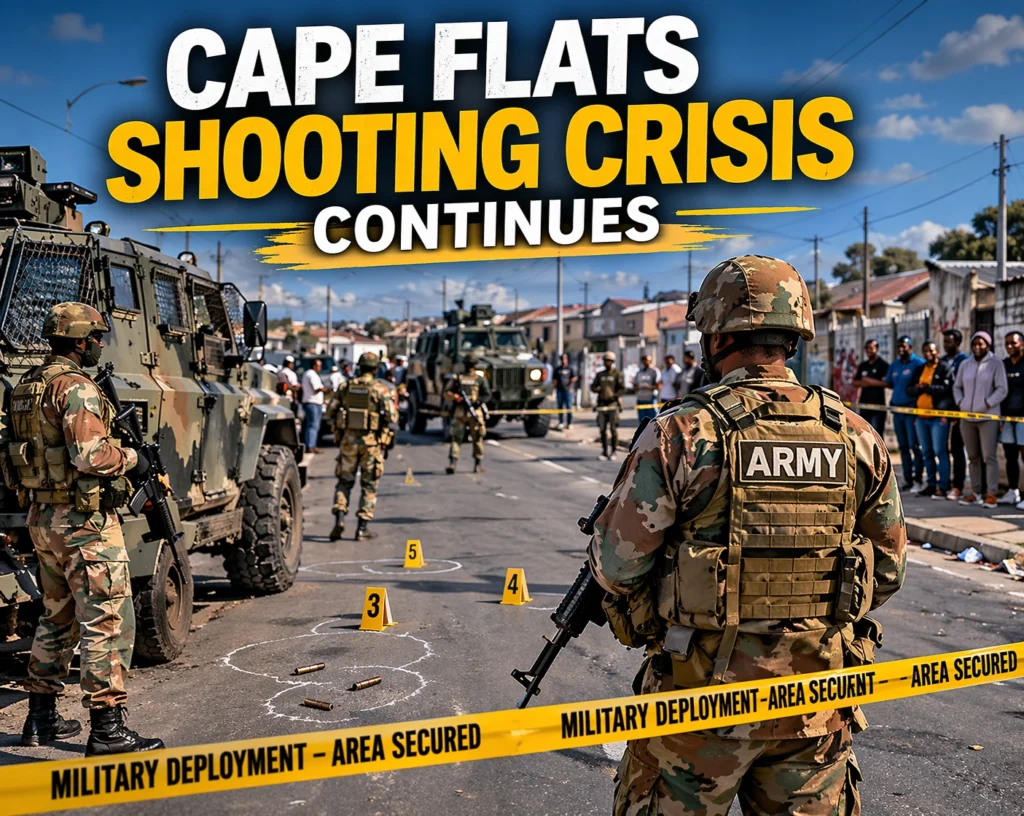
The Political Blame Game – Who Is Responsible?
The DA’s Criticism – A Lack of Transparency
The DA has been the most vocal critic of Operation Prosper. The party has raised concerns about the lack of transparency around the more than R800 million allocated to the deployment. “The minister and the chief of the army can find R2-million for a golf day, but they cannot produce a proper plan or the full troop numbers to protect our communities. That is a failure of priorities, and the people on the Cape Flats deserve better,” said Gotsell.
The City’s Response – Defending the Operation
City of Cape Town Mayco Member for Safety and Security, JP Smith, has defended the operation. “Already, the units are working well together. With the SANDF now as additional support, along with our LEAP, it allows for the sufficient required resources to follow up on intel received and to arrest those criminals that have been identified, some within recent shootings that have occurred,” Smith said.
What Needs to Change – A Path Forward
The R823 million spent on Operation Prosper could have gone a long way in addressing the root causes of crime: police underfunding, detective shortages, and social decay. “It can’t be right that almost a billion rand is spent on people to stand around on streets while real policing suffers,” the Sunday Times editorial concluded.
The deployment is now looking like a PR stunt ahead of what will be highly contested political terrain. Soldiers can stand on street corners. They can provide a visible deterrent. But they cannot investigate crimes. They cannot arrest suspects. And they cannot address the poverty, unemployment, and hopelessness that fuel gangsterism.
Final Thoughts: A Community Running Out of Patience
The shootings persist in Cape Flats despite army deployment because the army was never the solution. It was always a band-aid on a bullet wound.
The people of the Cape Flats have been failed. Failed by politicians who promise solutions but deliver photo opportunities. Failed by a police service that is underfunded and overwhelmed. Failed by a justice system that too often lets killers walk free.
A six-year-old girl lies in a hospital bed with a bullet in her head. A 13-year-old boy was executed in a granny flat. Dozens of families are planning funerals while soldiers stand on street corners, powerless to stop the next shooting.
The question is not whether the army can stop the violence. The question is whether South Africa is finally ready to address the real crisis: decades of police underfunding, detective shortages, and social neglect that have turned the Cape Flats into a war zone.
Until that changes, the bullets will keep flying. And the soldiers will keep watching.
Rest in peace to the victims. And may the community of the Cape Flats finally get the justice and safety they deserve.